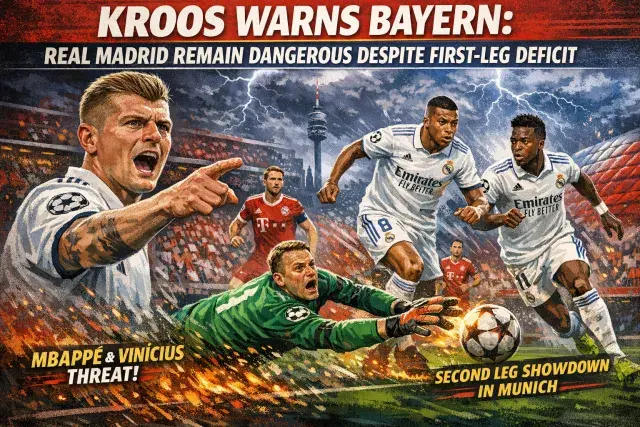

Toni Kroos, the former Real Madrid and Bayern Munich midfielder who retired in 2024 after a decade at the Spanish club, has cautioned against dismissing Real Madrid ahead of Wednesday's second leg in Munich. Speaking on his podcast Einfach mal Luppen, co-hosted with his brother Felix, Kroos argued that a one-goal deficit leaves the tie very much alive — and that Bayern's failure to press their advantage in the closing stages of Tuesday's first leg could yet prove costly.
A Cushion That Was Never Fully Pressed
Bayern went ahead through Luis Díaz shortly before half-time, then doubled their lead immediately after the break via Harry Kane. At that point, the tie appeared to be breaking decisively in Bayern's favour. What followed, however, surprised Kroos. "With a 2-0 cushion, we could have killed the tie mentally and dispelled any doubts," he said. "I was surprised that Bayern then sat back a bit and defended with less intensity."
Kroos had expected Bayern to keep control of the ball and extend their lead further. "I thought they would control the ball and add a third, fourth or fifth goal — but the opposite happened." Instead, Real grew increasingly assertive as the second half wore on. Manuel Neuer, now 40, produced a series of outstanding stops, but was eventually beaten in the 74th minute when Kylian Mbappé converted to make it 1-2 on the night. That away goal — and the manner in which it was conceded — fundamentally altered the psychological weight of the second leg.
The Mbappé and Vinicius Factor
Kroos's assessment of the second leg rests heavily on the individual quality Real carries in its forward line. He identified Mbappé and Vinicius Junior as the decisive variables, pointing specifically to the mismatches they can exploit against Bayern's defensive personnel. "Take Vini and Mbappé up against a Stanisic or a Laimer — there's always something to be had in a one-on-one; we don't need to discuss that," he said.
The underlying logic is sound. Bayern's defensive structure, while organised, has shown vulnerability when exposed to direct, high-speed pressure in wide areas. A single lapse in concentration — the kind Kroos explicitly referenced — can be enough when the opposition's forward options carry that level of threat. "You saw here: Bayern don't clear every danger; they will inevitably make the occasional mistake," he added.
However, Kroos tempered his confidence in Real's attacking depth with a clear-eyed structural concern. He warned that relying on counter-attacking moments alone will not be sufficient at the Allianz Arena. "At some point you have to open up, join the game and create your own answers," he said. "That's often been a problem; they've not been good enough at that." It is a diagnosis that points to a persistent tension in Real's approach: extraordinary individual quality coexisting with a dependency on reactive rather than proactive build-up.
Contrasting Domestic Form Ahead of the Decider
The broader context surrounding Wednesday's second leg could not present a starker contrast between the two clubs. Three days after Tuesday's defeat, Real drew 1-1 at home to Girona in LaLiga — a result accompanied by fresh refereeing controversy. Barcelona, meanwhile, were dominant in the city derby, winning 4-1 against Espanyol with Lamine Yamal outstanding throughout. That result extended Real's deficit in the domestic standings to nine points with seven rounds remaining.
Bayern's weekend went considerably better. A 5-0 victory at FC St. Pauli not only tuned their preparations for Wednesday but carried its own historical footnote: Leon Goretzka's decisive strike took Bayern past their own Bundesliga goals record from the 1971/72 season, reaching 105 goals across 29 matchdays — a number that reflects the clinical consistency of their attacking output this season.
Kroos's central thesis, nonetheless, holds a logic that European football history does not dismiss lightly. He put it plainly: "From Real's point of view, you have to be still in the game around the 70th minute to have a chance of progressing. If you reach that point at 0-0, 1-1 or even 1-0 ahead, you're still in the game mentally. Real will always be dangerous and will always be seen as dangerous, even by Bayern at home." Whether that reputation alone can bridge a one-goal gap — and the significant momentum differential — is the question Wednesday evening will answer.