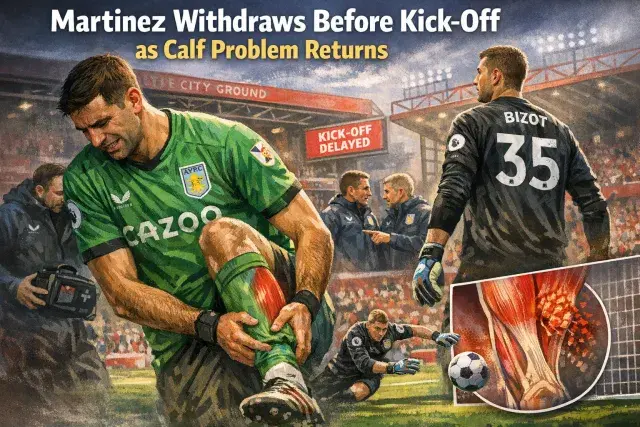
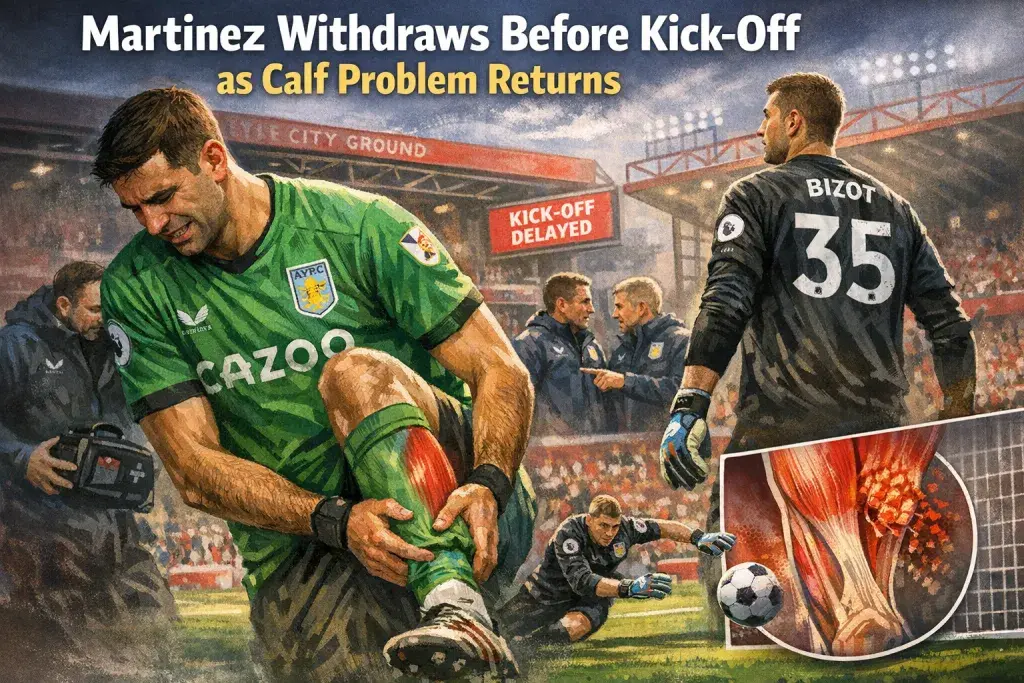
For the third time this season, Aston Villa were forced to reorganise their goalkeeping arrangements in the final moments before a fixture after Emiliano Martinez reported pain in his calf during the warm-up at the City Ground on Sunday. The World Cup-winning goalkeeper had been named in the starting line-up for the Premier League visit to Nottingham Forest but informed the coaching staff approximately 20 minutes before kick-off that he could not continue. Marco Bizot, 35, stepped in and kept a clean sheet across 90 minutes as Villa secured a 1-1 draw.
A Recurring Calf Complaint With No Clear Resolution
Calf injuries occupy a particularly frustrating category in professional sport medicine. The calf complex — comprising principally the gastrocnemius and soleus muscles, along with the Achilles tendon above — is subject to high eccentric loading in goalkeepers during explosive lateral movements, diving saves, and goal kicks. Recurring strain, where scar tissue forms inadequately or the underlying biomechanical cause is not addressed, can produce exactly the pattern Martinez has exhibited: intermittent flare-ups triggered not by a single traumatic event but by the cumulative stress of match-day preparation.
Martinez had already withdrawn under similar circumstances before fixtures against Feyenoord and Brighton earlier in the campaign, and was substituted at half-time during a goalless draw with Crystal Palace in January. That accumulation — four separate interruptions from one soft-tissue complaint — raises substantive questions about whether the 31-year-old's condition is being managed conservatively or whether a more definitive intervention is required. Emery was measured in his public response, saying only that Martinez "was feeling painful" and "not comfortable" during the warm-up. He declined to offer a prognosis or a projected return date.
The absence of a clear timeline matters in context. Villa remain in contention for a top-four finish, and Martinez's standing as one of the most capable goalkeepers in the Premier League is not in question. What is in question is his availability — and increasingly, his reliability in the final hour before a fixture, which creates a distinct logistical and psychological burden for a squad competing on multiple fronts.
Bizot Steps Up When the Moment Demands
The situation placed Marco Bizot in a position that would unsettle most experienced professionals: absorbing the news that he was now starting, with no forewarning, against a Forest side playing at home. The Dutch goalkeeper, who joined Villa from Brest last summer, handled the circumstance with composure. He made key stops to deny Neco Williams and Morgan Gibbs-White as Forest pressed for a winner in the second half. Emery was direct in his assessment: "Marco is really fantastic."
Bizot's performance carries genuine significance beyond the result. Villa's ability to absorb an unplanned absence of this magnitude — without visible structural disruption — speaks to the depth and professionalism the squad has developed under Emery's management. A deputy goalkeeper who can perform at Premier League level with minimal preparation time is not a given at most clubs. At 35, Bizot brings experience and composure that translate directly into reliability under pressure.
The Broader Challenge of Managing Elite Goalkeepers Through a Long Season
The Martinez situation reflects a wider challenge in elite football medicine: how to maintain a primary goalkeeper through a congested calendar when soft-tissue complaints resist clean resolution. Unlike acute fractures or ligament injuries, which follow broadly predictable recovery arcs, chronic muscular issues in the calf region can stabilise, then resurface unpredictably in response to temperature, fatigue, training load, or even the intensity of a warm-up on a cold afternoon in Nottingham.
Managing these conditions across a season requires a careful balance between rest, graduated loading, and competition readiness. The fact that Martinez continues to be named in starting line-ups suggests the medical staff believe him capable of completing fixtures when the warm-up produces no adverse response. But the pattern of late withdrawals indicates the margin between fit and symptomatic remains narrow. Whether that margin can be widened before the end of the season will depend on decisions made in the training room rather than on the pitch.
Emery, for his part, appears to have accepted the uncertainty as a fixed variable in his planning. His public comments have consistently redirected attention toward the response — toward Bizot, toward the squad's adaptability — rather than toward a solution for Martinez's calf. Whether that pragmatism reflects confidence in the medical process or simply a manager making peace with a problem he cannot control remains, for now, an open question.